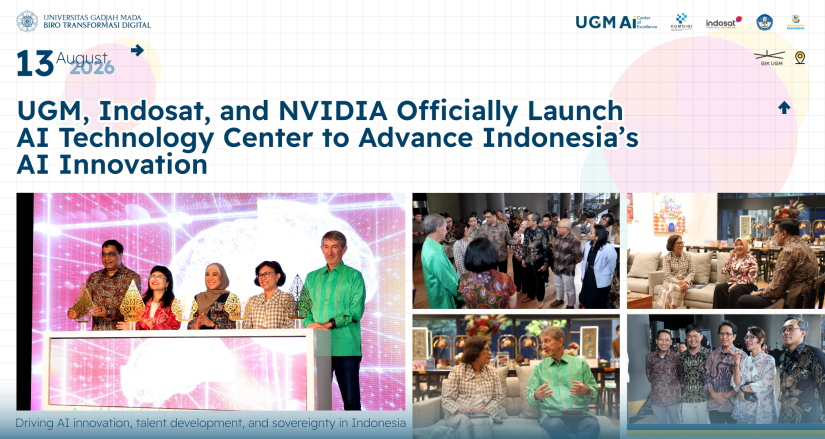
Yogyakarta, August 13, 2026 — Universitas Gadjah Mada (UGM), Indosat Ooredoo Hutchison (Indosat/IOH), and NVIDIA, together with the Ministry of Communication and Digital Affairs (Komdigi), officially launched the UGM Indosat NVIDIA AI Technology Center (NVAITC) at the Gelanggang Inovasi dan Kreativitas (GIK) UGM on Thursday (13/8).
The launch marks the establishment of Indonesia’s first university-based AI technology center, dedicated to advancing artificial intelligence research, innovation, and digital talent development. The center is part of the broader Indonesia AI Center of Excellence (AI CoE) initiative and brings together government, academia, industry, and global technology partners to accelerate applied AI research and develop solutions for Indonesia’s most pressing challenges.
The establishment of NVAITC represents a strategic step in Indonesia’s efforts to move beyond being an AI technology consumer and toward becoming a country that develops, creates, and contributes AI innovations with both national and global impact.
Strengthening UGM’s AI Ecosystem
UGM Rector, Prof. dr. Ova Emilia, Ph.D., said UGM has been committed since 2023 to optimizing the use of AI across education, research, and community engagement. One of the initiatives supporting this commitment is the development of UGM AI Society, which serves as a platform for interdisciplinary collaboration, research, innovation, and knowledge exchange in AI.
“Since 2023, UGM has been committed to realizing a smart university through the optimization of AI in education, research, and community engagement. One of these efforts is the initiation of UGM AI Society,” Ova explained.
According to Ova, AI research at UGM has continued to grow across a wide range of disciplines, including healthcare, agriculture, engineering, social sciences, and the humanities. These efforts include the use of AI in pandemic response, AI ethics, tuberculosis screening and diagnosis support, and smart agriculture.
The multidisciplinary nature of AI research at UGM is also reflected in the involvement of 18 faculties and two schools, with AI research being developed across different academic fields. Ova noted that more than half of student research at UGM is now related to AI in various applications.
Through NVAITC, UGM aims to expand access to advanced AI infrastructure and global expertise while strengthening interdisciplinary research in strategic areas such as healthcare, agriculture, and disaster resilience. The center is also expected to serve as a collaborative space that can be accessed by researchers and talents beyond UGM.
“This is not only for UGM. Universities across Indonesia can use the facilities, collaborate, and participate in these research activities,” Ova said.
From Indonesian Talent to Global AI Innovation
President Director and CEO of Indosat Ooredoo Hutchison, Vikram Sinha, emphasized that Indonesia has significant potential to become a creator of AI innovation.
He said Indonesia’s challenge is not a lack of talent, but unequal access to opportunities, infrastructure, and capabilities needed to develop that talent. For this reason, investment in people, research, and innovation must go hand in hand with investment in technology.
“80% is about people, then comes the platform and technology. Ultimately, people must lead and technology must remain human-centered,” Vikram said following the launch.
He stressed that AI development must ultimately translate into tangible benefits for society, particularly in sectors such as agriculture, healthcare, and education.
“Indonesia cannot remain a country that only consumes. We have to shift,” he said.
For Indosat, the partnership with UGM is therefore not simply about establishing an AI facility, but about creating a long-term ecosystem where research, infrastructure, and talent development reinforce one another.
The collaboration itself has evolved over several stages, beginning with the initiation of organizational governance in July 2025, followed by the signing of a Letter of Intent in early 2026, and culminating in the official inauguration of NVAITC on August 13, 2026.
Indosat has also set an ambitious target to support the development of up to two million AI-ready talents by 2030 through collaborations with UGM and other universities.
Bringing World-Class AI Infrastructure to Indonesian Researchers
Vice President of Solutions Architecture and Engineering at NVIDIA, Marc Hamilton, highlighted the critical role of computing infrastructure in enabling AI research and innovation.
He described an AI Factory as an infrastructure ecosystem that takes data as raw material, processes it using accelerated computing and AI technologies, and turns it into models and applications that generate value.
Indonesia already has a large base of developers and researchers. Hamilton noted that more than 500,000 Indonesian software developers are registered on GitHub, representing significant potential for AI development. However, realizing this potential requires access to high-performance computing, AI models, software, and technical expertise.
Through NVAITC, researchers and students will gain access to NVIDIA’s full-stack AI platform and Indosat’s GPU Merdeka sovereign GPU-as-a-Service platform. The center provides access to enterprise-grade accelerated computing, AI software, pretrained and open models, development frameworks, technical mentorship, training, and opportunities for industry collaboration.
NVIDIA is also making its open AI models and expertise available to Indonesian researchers and institutions, enabling them to build and adapt AI systems for their own needs.
Hamilton emphasized that this approach can help universities and companies develop their own AI capabilities without having to build every component of the AI stack from scratch.
Three Initial AI Projects for Indonesia
NVAITC will initially focus on applied AI research aligned with Indonesia’s strategic priorities. Three projects have been identified as the center’s initial flagship initiatives: eNose-TB, SmartAgri, and Tech4Disaster.
eNose-TB: AI for Accessible Tuberculosis Screening
Developed by researchers at UGM’s Faculty of Medicine, Public Health, and Nursing, eNose-TB is an AI-powered electronic screening technology designed to support tuberculosis detection through breath analysis.
The technology aims to make TB screening more affordable, rapid, and accessible, particularly for communities in remote and underserved areas where specialist expertise and advanced laboratory equipment may not always be available.
Dr. Dian Kesumapramudya Nurputra, M.Sc., Ph.D., Sp.A., lead researcher of the eNose-TB team, said the technology reflects a fundamental principle behind the center: solutions developed in Indonesia should be capable of addressing Indonesian challenges.
“Technology developed in Indonesia can solve Indonesian challenges,” Dian said, adding that access to world-class AI infrastructure and expertise would help accelerate the research toward affordable and accessible healthcare technologies.
SmartAgri: AI for Tropical Agriculture
The second initiative, SmartAgri, combines multimodal AI, edge computing, satellite imagery, sensor data, and local agricultural knowledge to support precision farming.
The system is designed to generate practical recommendations for farmers, including decisions related to irrigation and crop management, with the broader goal of improving agricultural productivity and resilience in Indonesia’s tropical environment.
Tech4Disaster: AI for Disaster Resilience
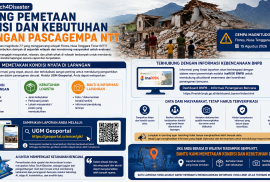
The third initiative, Tech4Disaster, focuses on disaster preparedness and response through geospatial AI.
The platform is designed to process satellite and sensor data using accelerated computing to improve situational awareness, disaster prediction, preparedness, and emergency response. The technology is particularly relevant to Indonesia, which faces significant risks from earthquakes, volcanic activity, floods, landslides, and other natural hazards.
Together, the three projects demonstrate the intended direction of NVAITC: using AI not simply as a technological experiment, but as a tool to address concrete challenges in healthcare, agriculture, and disaster resilience.
AI Sovereignty and Data Governance
Deputy Minister of Higher Education, Science, and Technology, Prof. Stella Christie, emphasized that AI development must be accompanied by strong data sovereignty.
She warned that Indonesia must ensure its data remains strategically valuable to the country rather than being given away without appropriate consideration of its economic and technological value.
“We may trade our data. We may sell our data in exchange for returns, but we must not simply give that data away”
She also called on NVAITC to establish clear targets and remain focused on solving real problems in Indonesia. In her view, AI centers should not stop at training activities or prototype development, but must anticipate future challenges and produce solutions that can be meaningfully adopted.
“The primary task of an AI center today, above all else, is to anticipate — to anticipate what will happen and when it will happen,” she said.
Stella further emphasized that AI adoption must begin with a clear understanding of the problem being addressed, the appropriate timing for adopting the technology, and the people responsible for operating it, while ensuring that humans remain in control.
AI Sovereignty Does Not Mean Isolation
Minister of Communication and Digital Affairs Meutya Hafid said UGM was selected as a partner after the government explored collaboration with several universities.
UGM ultimately stood out because of its commitment to research, the quality of its scientific work, and its strong track record in innovation.
According to Meutya, NVAITC is an important component of the Indonesia AI Center of Excellence, an initiative led by Komdigi with support from the Ministry of Higher Education, Science, and Technology.
The initiative reflects a broader national strategy to bring together government, universities, industry, and global technology companies to strengthen Indonesia’s AI capabilities.
Meutya also encouraged the use of sovereign cloud approaches, ensuring that critical data and infrastructure remain within Indonesian jurisdiction and meet the country’s security requirements.
However, she stressed that AI sovereignty should not be interpreted as technological isolation.
“AI sovereignty does not mean that Indonesia isolates itself or has to develop all technologies entirely on its own. Collaboration and sovereignty can go hand in hand,” Meutya said.
From Research Center to Long-Term AI Ecosystem
The establishment of NVAITC is also part of a much broader expansion of AI infrastructure in Indonesia.
Indosat is developing a large-scale AI Factory through Zankore, a joint venture involving Indosat, Ooredoo Group, Nokia, and NVIDIA. The project is planned to reach up to 1 gigawatt of AI Factory capacity, with the full-scale development potentially requiring investment of more than US$50 billion. This is a broader infrastructure initiative and is distinct from the NVAITC investment itself.
For NVAITC specifically, Katadata reported that the collaboration involves an initial investment of approximately Rp105 billion, comprising GPU credits and human-capital development. Indosat has also indicated its intention to expand its GPU-credit investment following the development of the center’s initial research outputs.
The broader strategy reflects a shift in how AI infrastructure is being developed in Indonesia: combining sovereign computing capacity, global AI technologies, local datasets, research institutions, and human talent into a connected ecosystem.
Measuring Success by Impact
For Meutya,
the success of NVAITC should not be measured simply by the number of training programs conducted or prototypes developed.
Instead, success should be reflected in the growth of AI talent and competencies, the adoption of research outcomes by society and industry, and the creation of intellectual property and innovations developed in Indonesia.
This perspective aligns with UGM’s ambition for NVAITC to become more than an infrastructure facility. The center is intended to serve as a bridge between research and real-world implementation, connecting Indonesian researchers and students with global expertise, advanced computing infrastructure, industry partners, and opportunities to scale their innovations.
As Ova emphasized, UGM hopes the collaboration will continue to generate innovative AI solutions that benefit Indonesia while contributing to the advancement of global science and technology.
The launch of UGM Indosat NVIDIA AI Technology Center therefore marks not simply the opening of a new facility, but the beginning of a longer-term collaboration to build Indonesia’s capacity to research, develop, deploy, and contribute AI technologies to the world.