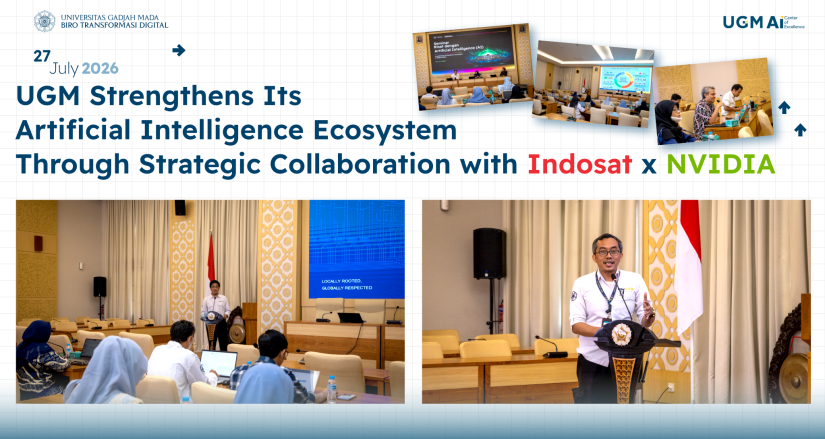
Yogyakarta, July 27, 2026 – Universitas Gadjah Mada (UGM) continues to strengthen its Artificial Intelligence (AI) ecosystem by fostering multidisciplinary collaboration that connects research, innovation, and technology development to address real-world challenges. This commitment was demonstrated through the UGM AI Seminar 2026, themed “Research with Artificial Intelligence (AI),” held at the Multimedia Hall, UGM Central Office Building, on Monday (July 27).
The seminar brought together researchers, faculty members, students, industry partners, and government representatives to share experiences in applying AI across diverse disciplines while showcasing innovative AI-powered solutions developed by UGM researchers. The presentations demonstrated how AI has evolved beyond a research support tool into practical solutions for law, energy, agriculture, healthcare, and disaster management.
Opening the seminar, Dr. Mardhani Riasetiawan, S.E., Ak., M.T., Head of UGM’s Bureau of Digital Transformation, emphasized that developing a robust AI ecosystem has become one of the university’s strategic priorities to strengthen research capacity, promote multidisciplinary collaboration, and accelerate digital transformation in higher education.
“Last year, we achieved an important milestone with the establishment of the UGM AI Center of Excellence. We were also honored to initiate a strategic collaboration with Indosat Ooredoo Hutchison,” he said.
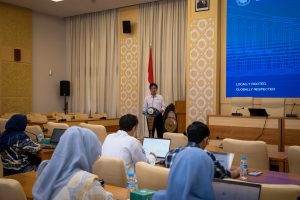
Dr. Mardhani explained that before the partnership was formalized, teams from Indosat Ooredoo Hutchison and NVIDIA conducted several site visits and comprehensive assessments of UGM’s research infrastructure and institutional readiness. Following these evaluations, UGM was selected to become part of the NVIDIA AI Technology Center (NVAITC) network.
According to him, one of the biggest challenges in AI research is the limited availability of high-performance computing resources required to train and deploy advanced AI models.
“The greatest challenge in AI development has always been computational resources. Through this collaboration, we hope UGM researchers will gain access to significantly greater computing capacity than ever before,” he explained.
Beyond strengthening computational infrastructure, UGM has also launched several strategic initiatives to cultivate its AI ecosystem, including the Artificial Intelligence Talent Factory (AITF) and the establishment of the UGM AI Faculty Members Network, which brings together researchers from various faculties to encourage interdisciplinary collaboration.
Dr. Mardhani highlighted that UGM’s greatest strength lies in its multidisciplinary nature.
“What we value most in this collaboration with NVIDIA is UGM’s multidisciplinary character. Our approach goes beyond technical aspects by actively involving researchers from social sciences, humanities, health sciences, agriculture, engineering, and many other disciplines.”
He added that the university aims to develop an AI ecosystem collaboratively.
“We want to build this ecosystem together because no significant achievement can ever be accomplished alone.”
One of the key outcomes of the collaboration with Indosat Ooredoo Hutchison and NVIDIA is the provision of Artificial Intelligence Infrastructure as a Service (AI Infrastructure as a Service – AIaaS). Through this initiative, researchers gain free access to enterprise-grade GPU computing infrastructure for developing, training, and deploying AI models without the need to invest in their own high-performance computing facilities.
This shared infrastructure has significantly accelerated experimentation, model development, and multidisciplinary AI research across the university.
The seminar featured numerous research projects that have benefited from this AI infrastructure.
From the Faculty of Law, Dr. Rimawati, S.H., M.Hum., demonstrated how Artificial Intelligence is transforming legal research by assisting researchers in searching legal regulations, analyzing court decisions, and organizing legal references. Tasks that previously required weeks of manual work can now be completed within hours. Nevertheless, she emphasized that AI should remain a research assistant rather than replacing legal scholars, as every AI-generated output must still be verified against authoritative legal sources.
Another presentation by Prof. Dr. Ir. Ferian Anggara, S.T., M.Eng., IPM., from the Faculty of Engineering, showcased the application of machine learning in mineral and energy exploration. By integrating geological datasets with AI-based predictive modeling, researchers can identify mineral potential more efficiently, reducing both exploration time and operational costs.
One of the seminar’s major highlights was presented by Dr. Andri Prima Nugroho from the Faculty of Agricultural Technology, who introduced UGM’s AI-driven Smart Agriculture initiatives.
His research integrates machine learning, computer vision, Internet of Things (IoT) technologies, environmental sensors, drones, multispectral imagery, and weather data to transform agricultural data into intelligent recommendations that support precision farming.
The technologies showcased include the SIPASI Smart Irrigation System, AI-powered greenhouses, plant factory technologies, crop health monitoring using unmanned aerial vehicles, fertilizer decision-support systems, and AI-based knowledge management platforms. According to Dr. Andri, AI in agriculture must be developed based on local conditions and through close collaboration among researchers, farmers, government agencies, and industry partners to produce solutions that are both scientifically sound and practically applicable.
The seminar also presented the development of an AI-powered electronic nose (e-Nose) platform, which combines advanced sensor technologies with artificial intelligence algorithms to recognize complex odor patterns automatically. Supported by the AI infrastructure provided through the collaboration with Indosat Ooredoo Hutchison and NVIDIA, this technology has the potential to support rapid disease screening, healthcare diagnostics, food quality assessment, and industrial monitoring.
Another research showcase came from Dr. Nur Mohammad Farda of the Faculty of Geography, who introduced Tech4Disaster, a GeoAI platform integrating geospatial technologies, IoT, satellite imagery, drones, big data, and artificial intelligence into a comprehensive disaster management ecosystem.
The platform supports the entire disaster management cycle—from mitigation and preparedness to emergency response and post-disaster recovery—by transforming large volumes of spatial data into actionable real-time intelligence. Applications demonstrated during the seminar included rapid disaster mapping, AI-based damaged-building detection using deep learning, participatory needs mapping, and geospatial disaster information portals that assist emergency response agencies in making faster and more informed decisions.
The seminar clearly illustrated that Artificial Intelligence at UGM has progressed far beyond being merely a research tool. Across multiple disciplines—including law, engineering, agriculture, healthcare, and disaster management—AI is now enabling innovative solutions with tangible societal impact.
Through its strategic collaboration with Indosat Ooredoo Hutchison and NVIDIA, UGM is not only strengthening its computational capabilities but also accelerating the development of impactful AI research. The availability of AI Infrastructure as a Service (AIaaS) has become a critical foundation for enabling multidisciplinary AI innovation while reinforcing UGM’s commitment to building a collaborative, sustainable, and globally competitive AI ecosystem that contributes to Indonesia’s digital transformation.