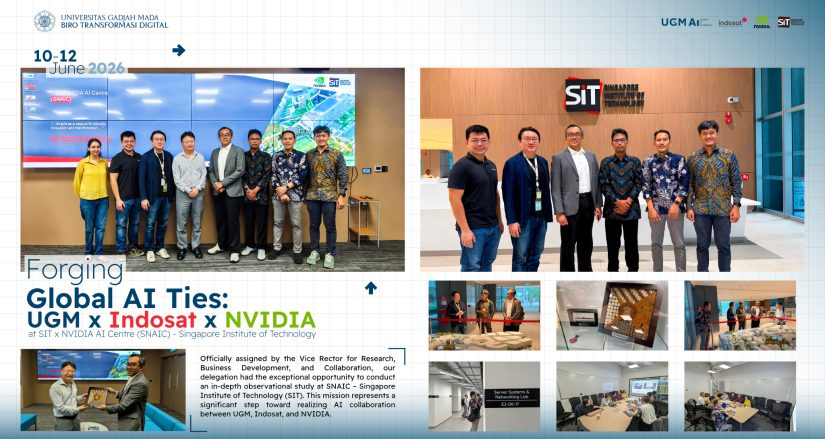
SINGAPORE – The Digital Transformation Office (BTD) team of Universitas Gadjah Mada (UGM) recently concluded a strategic mission during an observational study visit to the Singapore Institute of Technology (SIT) from June 10 to 12, 2026. This cross-disciplinary delegation’s visit is part of a strategic initiative under the direction of the Vice Rector for Research, Business Development, and Collaboration of UGM, with the primary mission of following up on the collaborative plans between UGM, Indosat, and NVIDIA to establish a tangible Artificial Intelligence (AI) ecosystem for both industry and society.
The main focus of this observational study was to delve into the operations of the NVIDIA Joint Center at SIT, professionally known as SNAIC (SIT-NVIDIA Artificial Intelligence Centre). Through this visit, the UGM team explored the operational practices of a world-class AI research center, future-ready technological infrastructure management, and implementation strategies for innovation programs that bridge academia with global industry leaders.
Welcomed by Key Figures in Singapore’s AI Ecosystem
Throughout the observational series at the SIT campus, the UGM delegation was welcomed by and engaged in intensive discussions with leading figures and principal researchers driving Singapore’s AI ecosystem. The strategic meeting was directly accompanied by A/Prof. Daniel Wang, Co-director of SNAIC and Director of the SIT Data Science & AI Lab, alongside Ng Aik Beng, Ph.D., Senior Regional Manager at NVIDIA AI Technology Center Asia Pacific South, who brings over two decades of industry expertise.
Also present to enrich the cross-disciplinary technical exchange were top-tier researchers from SNAIC, including Dr. Timothy, a Natural Language Processing (NLP) expert and SUTD alumnus; Dr. Akshita Abrol, a Post-Doctoral Fellow focusing on AI-based speech analysis for diagnostic healthcare; and Isfaque, a Research Engineer specializing in security data analytics, Graph Neural Networks, and Machine Learning.
A Cross-Disciplinary Approach for Real-World Solutions
The quality of the discussions became highly focused on actionable solutions, thanks to the multidisciplinary composition of the UGM delegation. Led by experts in their respective fields, the UGM team comprised Ir. Andri Prima Nugroho, S.T.P., M.Sc., Ph.D. (agricultural informatics expert), Dr. Nur Mohammad Farda, S.Si., M.Cs. (remote sensing expert), dr. Dian Kesumapramudya Nurputra, Sp.A., Ph.D. (pediatric neurology expert), and Muhammad Alif Taufiqurrahman, S.Kom. (Systems Analyst).
The inclusion of experts from diverse backgrounds breaks the traditional stereotype that AI development belongs solely to pure computer scientists. A fascinating synergy emerged during the discussions; for instance, the AI research for medical devices presented by dr. Dian (UGM) found a strong common ground with the diagnostic healthcare research focus of Dr. Akshita (SNAIC). AI applications at UGM are specifically designed to solve concrete problems—ranging from optimizing cutting-edge agriculture, extracting satellite imagery for disaster management and mitigation, to innovating intelligent algorithms to support the precision of pediatric medical devices in hospitals.
Bridging Academia and Global Industry
Through deep observation alongside SNAIC leadership, the UGM delegation studied the three-prong governance model driving the AI center: Industry Enablement (accelerating AI adoption in business), Applied Research & Development (industry-scale applied research), and Talent Development (cultivating job-ready digital talent).
SNAIC demonstrated how a higher education institution transforms from a purely academic approach toward creating direct impact. One prominent example studied was the implementation of the Industrial Doctorate program, where doctoral-level research is fully aligned with industry projects to solve real challenges within the business and operational sectors.
Becoming a Beacon of AI Innovation in Indonesia
The insights gathered from this visit with SNAIC’s leadership and researchers will serve as a vital foundation for UGM in formulating an academic-industry collaboration model with Indosat and NVIDIA in Indonesia. This strategic partnership aims to build a center of excellence in AI that functions as a national beacon of innovation. This upcoming AI center will not only coordinate scattered internal research across the university but also foster solid trust from both industry and government to accelerate technological leaps in the country.