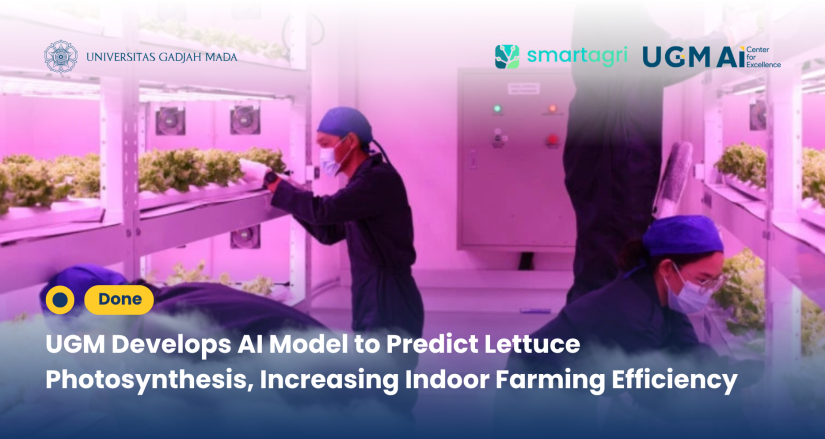
Universitas Gadjah Mada Develops AI Model to Predict Lettuce Photosynthesis, Improving Indoor Farming Efficiency
Yogyakarta – Andri Prima Nugroho, STP., M.Sc., Ph.D., IPU, ASEAN Eng., APEC Eng., from the Faculty of Agricultural Technology at Universitas Gadjah Mada (UGM), successfully completed a research project in 2025 focusing on the development of a predictive model for the photosynthesis rate of lettuce (Lactuca sativa L.) in indoor farming systems. Using the Random Forest algorithm, this model is designed to provide accurate estimations of photosynthesis based on environmental and plant physiological data, serving as a crucial foundation for optimizing indoor agricultural production.
This research addresses the need for efficiency and precision in controlled-environment agriculture such as indoor farming. The photosynthesis rate is a key indicator of plant health and productivity, yet manual measurement is often time-consuming and less accurate. By leveraging the Random Forest Machine Learning algorithm, the UGM research team has developed a model capable of predicting photosynthesis rates automatically and in real time.
“This model will be a valuable tool for indoor farmers,” explained Andri Prima Nugroho. “With accurate photosynthesis estimations, they can make better decisions in regulating environmental conditions such as light intensity, temperature, humidity, and CO₂ concentration, thereby maximizing plant growth and resource efficiency.”
This internally funded research also involves collaboration with external partners, both national and international, reflecting Universitas Gadjah Mada’s commitment to delivering relevant technological solutions for modern agriculture. The output of this research is a model and algorithm ready for implementation to support precision farming practices.
It is expected that this AI-based photosynthesis prediction model will be widely adopted, contributing to increased productivity and sustainability in indoor farming systems, as well as supporting food security through agricultural technology innovation.