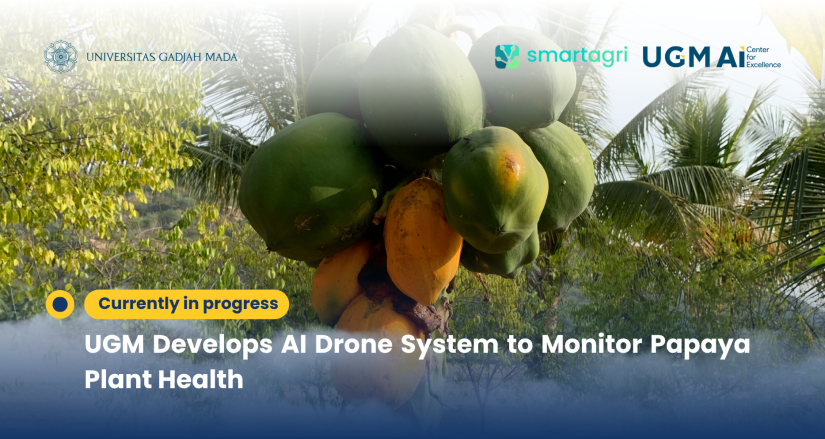
Yogyakarta – Ardan Wiratmoko, S.T.P., M.Sc, a researcher from the Faculty of Agricultural Technology at Universitas Gadjah Mada (UGM), is leading the development of an innovative system to evaluate the health of papaya plants (Carica Papaya L.). This system utilizes Vertical Take-Off and Landing (VTOL) drone technology equipped with multispectral sensors, with data analysis using a Computer Vision approach, aiming to support more precise cultivation management.
The research, which began in 2025, focuses on the use of advanced technology to detect the physiological condition of papaya plants non-invasively. VTOL-type drones are chosen due to their ability to take off and land vertically, allowing flexible data collection in plantation areas. The multispectral sensors on the drone will capture spectral data from the plant canopy, which is then processed using Computer Vision algorithms.
“This system is designed to provide spatial information regarding the health status of papaya quickly, accurately, and efficiently,” explained Ardan Wiratmoko. “By detecting differences in plant physiological conditions early, farmers can take appropriate preventive or corrective actions, thereby minimizing losses and increasing yields.”
This research, funded by the Faculty’s DIPA, is a collaborative project with external partners, both domestic and international, demonstrating UGM’s efforts to deliver globally relevant agricultural solutions. Although still in the development stage, this study is expected to produce models/algorithms as well as innovation videos/posters that can serve as practical guidelines for the agricultural industry.
The development of this system marks a significant step forward in the application of AI technology in the agricultural sector, particularly for papaya cultivation. It is expected that this innovation will pave the way for smarter and more sustainable farming practices, ensuring optimal and healthy papaya production in the future.