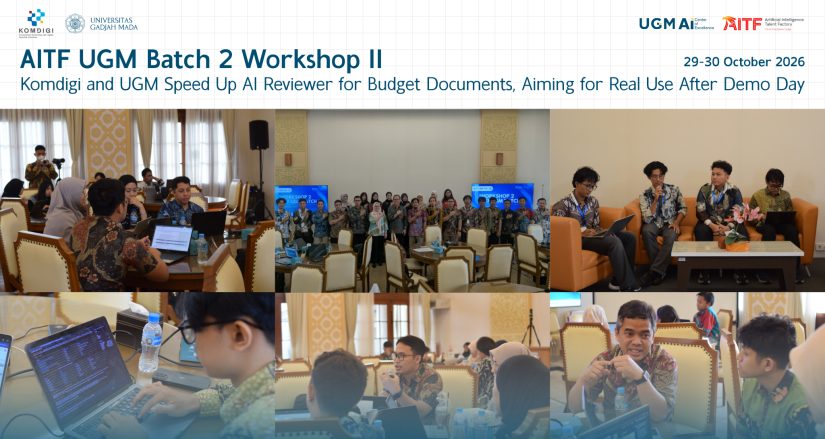
Workshop II of the AI Talent Factory UGM Batch 2 serves as the phase-two checkpoint: datasets remain the main challenge, while AI security and ethics are kept in view.
Yogyakarta, 30 October 2026 – The Ministry of Communication and Digital Affairs (Komdigi) and Universitas Gadjah Mada (UGM) held Workshop II of the Artificial Intelligence Talent Factory (AITF) UGM Batch 2 program on 29–30 October 2026 at the UGM campus. The workshop reviewed phase-two progress of two student teams building an AI-driven review system for Terms of Reference (TOR) and Budget Plan (RAB) documents used by Komdigi’s Planning Bureau.
Participants included leaders of the Digital Talent Development Center at Komdigi’s Human Resources Development Agency (BPSDM), the Directorate of Artificial Intelligence and New Technology Ecosystem, Komdigi’s Planning Bureau, representatives of the UGM Vocational School, faculty advisors, technical mentors, and students from Computer Science, Information Technology, and Internet Engineering Technology programs.
Not Stopping at a Prototype
Gunawan Hutagalung, Head of the Digital Talent Development Center at BPSDM Komdigi, said dataset quality is the biggest challenge in this phase. A strong pipeline and model will still deliver low accuracy if the training data is weak, he noted.
“We cannot rely on datasets we create ourselves. What we need most is real data that has been properly masked,” he said. He stressed that the AITF output must be a minimum viable product actually implemented within Komdigi, not merely a prototype.
A representative of the UGM Vocational School welcomed the program and reminded participants to keep clear ethical boundaries as AI makes so much easier.
On the user side, the Planning Bureau acknowledged that data provision during the pilot has not been optimal, as it requires coordination with the Inspectorate and budget teams. The Bureau hopes the system can adapt to constantly changing budgeting regulations, and said it has prepared for the application’s continuity after the pilot, including infrastructure.
Two Layers of Review: Rules and LLM
The system works in two layers. The first is a rule engine that checks document identity fields such as ministry, echelon unit, program, and output details. The second uses a large language model (LLM) to assess the narrative sections of a TOR, from background to risk management. It returns a status, reasoning, the problematic section, and recommended fixes, all of which are still verified by staff.
Team A, which handles completeness checks, reported PDF-based TOR and RAB extractors that can now read borderless tables and timeline tables, and detect signatures and employee ID numbers. From about 164 TOR documents, the team built 120 balanced samples of complete documents and documents deliberately given defects for model training. The team has also run continued pretraining on Qwen3 models of 1.7B and 4B parameters using about 10 million tokens of Indonesian text.
Discussions with the Planning Bureau mapped the errors most often found in practice, including missing signatures, the wrong budget year, omitted risk-management sections, and merged sub-sections. These findings will guide the variety of training data. Komdigi’s technical team also asked that the models used be as small as possible while proven optimal through evaluation metrics.
Responsible AI and Document Manipulation Risks
On the second day, the Directorate of Artificial Intelligence and New Technology Ecosystem presented how Responsible AI applies to this use case. The session covered data governance, bias and jailbreak evaluation, model transparency, audit trails, and personal data protection under Indonesia’s Personal Data Protection Law (UU PDP).
The team also mapped loopholes document submitters could use to trick the AI, such as white or tiny text, invisible characters, number manipulation, and splitting procurement packages to avoid mandatory tenders. As countermeasures, participants were advised to extract documents as images and to calculate budgets with formulas rather than leaving arithmetic to the LLM.
The workshop closed with several follow-up agreements. Team A will continue with RAB identity and calculation checks, while Team B focuses on substantive review based on reference documents. Detecting split procurement was logged as a later enhancement. Participants have one more workshop before Demo Day, where all solutions will be presented as ready-to-use products.