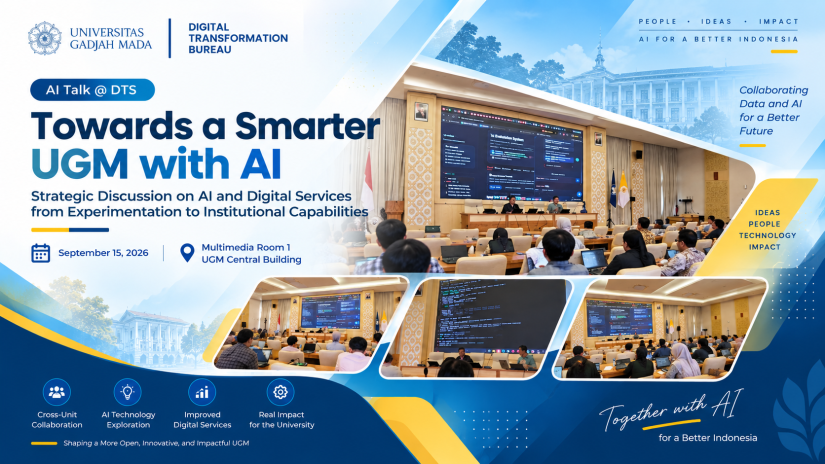
Yogyakarta, September 15, 2026 — Universitas Gadjah Mada continues to strengthen the use of Artificial Intelligence (AI) to support digital transformation across the university. Through Ngobrol AI @ DTS, the UGM Digital Transformation Bureau (BTD) discussed developments in digital services while exploring the implementation of AI and Agentic AI to support a range of institutional needs.
Held on Tuesday (September 15), the event featured presentations on technology and digital service developments, cross-unit discussions, and a hands-on session on Agentic AI. The discussions highlighted how AI adoption at UGM has evolved from individual chatbot use toward broader experimentation involving agentic AI, computer vision, document intelligence, research computing, and the integration of AI into institutional services.
During the event, BTD presented several prototypes and pilot projects currently under development. These included a meeting transcription engine, UGM Agent, a CCTV-based Vision Agent, document and library digitization, exploration of three-dimensional mapping using drones, GPU-based Jupyter environments for research computing, and an LLM Router to manage access to various AI models while monitoring token consumption.
These initiatives indicate that AI at UGM is increasingly being positioned not merely as a technology for individual use, but as part of the university’s broader digital ecosystem. While some capabilities are already operational, others remain at the sandbox and development stages.
Building an Institutional AI Architecture
The Ngobrol AI @ DTS discussion also highlighted the importance of establishing an institutional AI foundation encompassing data, knowledge, models/providers, applications, agents, computing, security, costs, and governance.
The emerging approach places data governance at the foundation. UGM data needs to be managed according to its level of sensitivity, while applications should be designed to avoid dependence on a single AI model or provider. At the same time, agents should be granted capabilities according to their authorized access rights.
This principle is summarized as:
Data is governed → Models are replaceable → Applications are model-agnostic → Agents are permission-controlled.
Through this approach, the use of both external and locally hosted AI models can be managed through a more controlled architecture, while providing the university with greater flexibility in selecting technologies according to its needs.
DTS as an AI Experimentation Sandbox
In the development of AI at UGM, DTS serves as an institutional sandbox. This experimentation environment is intended to demonstrate feasibility, identify risks, and generate evidence before a technology is further developed into an institutional service or policy.
Several use cases discussed during the event included AI applications for accreditation, document and library digitization, meeting-to-action, institutional knowledge, Vision Agent, research assistants, engineering operations, and student services.
This use-case-driven approach enables AI development to be guided by actual user needs. As a result, technology is considered not only based on model capabilities, but also on its potential benefits, data readiness, risks, and user requirements.
Strengthening Research Computing and LLM Access
Beyond use-case development, infrastructure is another important component of UGM’s AI ecosystem. BTD has demonstrated the feasibility of GPU-based Jupyter environments, opening opportunities for the development of controlled shared computing services to support research activities.
Meanwhile, the LLM Router is viewed as a strategic component for abstracting the use of different AI models and providers. It can support model routing, consumption monitoring, budget and quota management, and reduce dependence on a single AI model provider.
The development of institutional knowledge/memory is another area being explored. Institutional knowledge, policies, regulations, SOPs, and documents can be provided as context for agents. However, its implementation requires clear management of source authority, versioning, access control, provenance, and validation mechanisms.
Exploring Agentic AI through Hermes
One of the activities featured a hands-on session using Hermes, serving as an initial experiment in applying Agentic AI among users with diverse backgrounds.
The experiment is designed for limited-scale use on personal computers. BTD provides access to LLMs and tokens for 30 days, allowing participants to explore the use of agents within their respective work contexts.
The results of the Hermes experiment can subsequently serve as evidence for evaluating productivity, usability, security risks, competency requirements, costs, and governance needs before determining potential further development and broader institutional adoption.
From Experimentation to Institutional AI
Moving forward, BTD is prioritizing several initiatives, including the development of specialized AI use cases with clearly defined target users, the enhancement of the Vision Agent and transcription services, and the continuation of library and document digitization pilot projects using official data with appropriate authority and permissions.
UGM also needs to develop AI and Agentic AI guidance and governance based on evidence from experimentation, establish governance for research computing and GPU resources, strengthen the LLM Router, and develop the concept of institutional knowledge/memory with clear authority and provenance.
These initiatives reflect UGM’s emerging direction from technology exploration toward institutional AI architecture and governance, following a progression of:
Explore → Prototype → Evaluate → Risk → Formulate Governance → Institutionalize
By consolidating existing experiments into a portfolio of use cases, establishing shared architecture and governance, and providing managed computing infrastructure and LLM access, AI can evolve from a collection of individual experiments into an institutional capability at UGM that is governed, reusable, scalable, secure, and cost-aware.