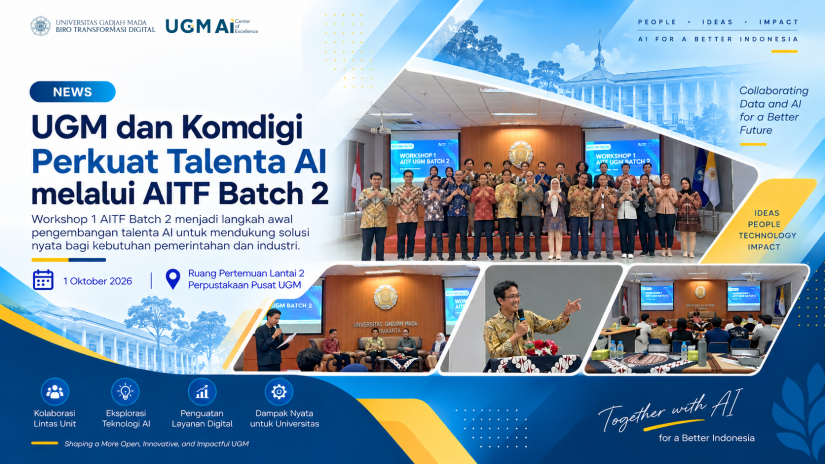
Yogyakarta, October 1, 2026 – Universitas Gadjah Mada (UGM), in collaboration with the Ministry of Communication and Digital Affairs (Komdigi), continues to strengthen the development of Artificial Intelligence (AI) talent through the Artificial Intelligence Talent Factory (AITF) UGM Batch 2 program. The first day of Workshop 1 was held on Thursday (October 1) at the Meeting Room, 2nd Floor, UGM Central Library.
Organized by the Digital Talent Development Center of Komdigi in collaboration with the Digital Transformation Bureau (BTD) UGM, the program provides a learning and collaborative environment for participants to develop AI solutions based on real-world government needs. On the first day, the workshop focused on establishing a shared understanding of the use case “AI-Driven Review System for Program Work Document Evaluation,” proposed by the Planning Bureau of Komdigi.
The workshop began with an opening session and an overview of the strategic direction for AI talent development. Head of BTD UGM, Dr. Mardani Ria Setiawan, expressed his appreciation for the implementation of AITF as part of efforts to strengthen the UGM.AI ecosystem and UGM’s contribution to the development of the Indonesia AI Center of Excellence.
Mardani also emphasized the importance of connecting talent development with the research ecosystem and computational infrastructure. According to him, strengthening computational capacity is an important component in supporting AI development at UGM.
Meanwhile, Head of the Digital Talent Development Center of Komdigi, Dr. Gunawan Hutagalung, in his official opening of Workshop 1, outlined the direction of AITF’s development toward a broader ecosystem. The program is planned to evolve from a talent development initiative into an AI Talent Hub/AITF Center in Indonesia, including through stronger networks with higher education institutions and the establishment of AI Labs.
The program is also expected to expand into industry use cases in the following year, including logistics, supply chain, transportation, and video. Through this approach, the program is expected to produce not only AI talent but also AI solution prototypes that can be further developed in collaboration with users and industry partners.
Emphasizing Responsible and Ethical AI
In addition to technical development, Workshop 1 placed particular emphasis on Responsible and Ethical AI. The session was delivered by Haryu Kresno Wididibranto, representing the Director of Artificial Intelligence and New Technology Ecosystem at Komdigi. The session highlighted the importance of developing AI systems that are trustworthy, secure, transparent, accountable, and that maintain human involvement in decision-making processes.
The session emphasized principles including human-in-the-loop, risk mitigation, personal data protection, transparency, accountability, accessibility, security, environmental sustainability, and intellectual property protection as key components of AI ethics.
This approach is particularly relevant to the use case being developed through AITF Batch 2. The proposed system is not intended to replace human decision-making, but rather to provide analytical support and recommendations. Final decisions remain with the Planning Bureau as the owner of the business process.
Developing AI for Planning Document Review
During the use case introduction session, Maldini Maulana Ibrahim, representing the Planning Bureau, explained the need to develop an AI-Driven Review System. The system is designed to support the evaluation of Terms of Reference (TOR) and Budget Plans (RAB).
The solution is being developed in response to the need to improve consistency in the quality of planning and budgeting documents, establish a quality gate mechanism, and support the alignment of proposals with established priorities.
Under the proposed process, work units will upload TOR and RAB documents in digital format. The AI system will then analyze the documents, provide labels and categorizations, and generate explanations and recommendations. The results will subsequently be verified by the Planning Bureau through a human-in-the-loop mechanism. Documents may then be approved, returned for revision, or forwarded to the next stage.
Participants Begin Building the Solution Foundation
Workshop 1 also provided an opportunity for the two participant teams to present their initial progress in developing the solution. Team A focuses on document extraction, formatting, and completeness using rule-based approaches and parsers, while Team B focuses on content analysis and categorization using Large Language Models (LLMs) and Retrieval-Augmented Generation (RAG).
During the initial phase, Team B has developed a UI/UX design, database structure, and RAG pipeline connecting document extraction, tabular data storage and vector databases, embedding, retrieval, and LLM processing to generate classifications, explanations, and supporting evidence.
Meanwhile, Team A has developed parsers for DOC, Excel, and PDF documents, including page-level table detection, Markdown conversion, JSON output generation, and a checklist engine for checking document format and completeness.
The development process continues to face several challenges, particularly variations in TOR formats across units, OCR quality, limitations in masked data, and the unavailability of masked RAB documents as part of the development dataset. Based on the workshop summary, 29 masked TOR documents are currently available out of approximately 267 TOR documents, while masked RAB data is not yet available.
Toward a More Structured AI Model Development
During the discussion session, mentors and faculty tutors provided a number of technical recommendations to strengthen the solution. One recommendation was to standardize document inputs in PDF format and separate TOR and RAB documents while linking them through the appropriate identifiers or codes.
The teams were also encouraged to strengthen the RAG approach, develop a more diverse Supervised Fine-Tuning (SFT) dataset if needed, select embedding models that support the Indonesian language, and implement document versioning and revision history.
Following Workshop 1, both teams will continue developing synthetic data, preparing the SFT dataset, aligning JSON formats across pipelines, building the production database using PostgreSQL and Qdrant, and coordinating further on the data masking mechanism.
Connecting Talent, Technology, and Real-World Needs
Workshop 1 of AITF Batch 2 demonstrates an approach to AI talent development that goes beyond technology learning. The program also emphasizes participants’ ability to understand real-world problems, business processes, user requirements, data, as well as AI governance and ethical considerations.
By bringing together participants, use case owners, Komdigi mentors, UGM faculty tutors, and the solution and PMO teams, AITF provides a collaborative environment for translating organizational needs into AI solutions that can be developed progressively.
Workshop 1 of AITF Batch 2 will continue on Friday, October 2, 2026, with further development activities by each participant team.