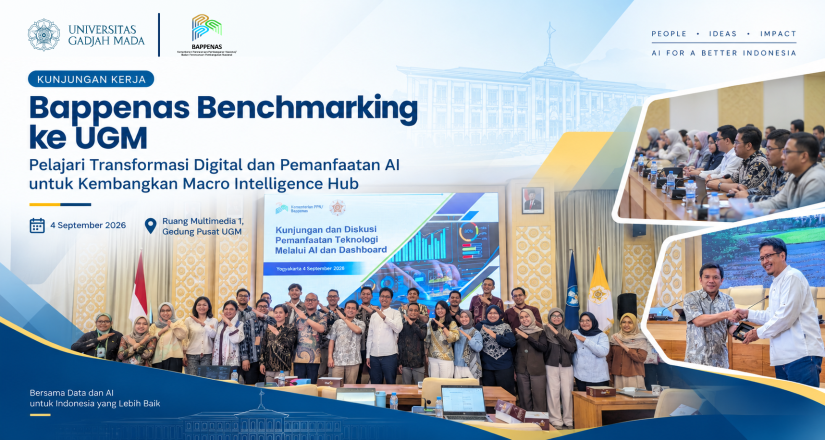
Yogyakarta, September 4, 2026 — The Ministry of National Development Planning/National Development Planning Agency (Ministry of PPN/Bappenas) conducted a working visit and benchmarking session at Universitas Gadjah Mada (UGM) to learn about the use of Artificial Intelligence (AI), as well as the development and management of dashboards.
The activity, themed “Strengthening Knowledge Management, Digital Technology Utilization, and Dashboard Development,” took place at Multimedia Room 1, 3rd Floor, North Wing of UGM’s Central Building, Bulaksumur.
The visit forms part of preparations by the Deputy for Macro Development Planning at Bappenas to develop the Macro Intelligence Hub (MIH) and an internal dashboard for the Deputy’s Office. The Bappenas delegation, consisting of staff from work units responsible for knowledge and data management as well as dashboard development, was welcomed by UGM’s Digital Transformation Bureau (Biro Transformasi Digital/BTD).
In an official request letter sent by the Secretary of the Deputy for Macro Development Planning, Ewin Sofian Winata, the visit was intended to enable Bappenas to learn directly from an institution with experience in digital technology and data management, making UGM an important reference for its digital transformation efforts.
Four Years of UGM’s Digital Transformation Journey
During the discussion, the UGM team, led by the Head of the Digital Transformation Bureau, presented the university’s digital transformation journey over the past four years. The presentation covered the development and structuring of enterprise architecture, the development of data dashboards, the adoption of AI and agentic AI, as well as flagship research initiatives with direct impact on society.
One of the key insights shared with the Bappenas delegation was that the core challenge in developing dashboards and AI systems lies not simply in the data or technology, but in business processes.
For this reason, UGM did not move directly into developing AI systems. Instead, the university began by structuring its Enterprise Architecture during the first 1.5 to 2 years of its transformation journey.
“One hundred motorcycles are not simply one hundred motorcycles; they represent one hundred instances of the process of parking a motorcycle,”
the UGM team explained, illustrating why business processes must be properly understood before digital systems are built.
This early investment resulted in four major components: business processes, data, applications, and technology. Thousands of business processes across UGM have since been mapped, providing a foundation for the development and integration of subsequent digital systems.
From Intelligent Dashboards to Agentic AI
Building on this foundation, UGM presented a range of systems that have already been developed and are currently in operation, including:
- Intelligent Dashboard, developed in collaboration with the Ministry of Communication and Digital Affairs (Komdigi). The system crawls social media and mass media content and applies AI-based sentiment analysis to help detect emerging issues at an early stage.
- Service Queue System, developed by UGM’s internal team with the assistance of AI for technical development and now operating as part of UGM’s service delivery.
- AgenDKI, an agentic AI platform that provides shared access to AI tokens and subscriptions, enabling staff to build their own AI agents or dashboards without having to wait for the IT team’s development ticket queue.
- Hermes, a general-purpose AI agent platform that supports a range of activities, including coding assistance, research, and server management.
- Agentic Visual Applications, covering applications such as CCTV-based people counting and anomaly detection, library document digitization—from scanning and conversion to AI-based querying—and automated meeting minute-taking.
- Automated SDG and Key Performance Indicator (IKU) Reporting, in which AI automatically maps campus news and activities to relevant SDG indicators and IKU, reducing the need for previously manual reporting processes.
- Indonesian-Language AI Models, with further development toward regional languages. These models are designed to better address Indonesian and local contexts than general-purpose global AI models.
Throughout the development of these systems, the UGM team emphasized a key principle: AI is intended to reduce technical and repetitive workloads, not to replace people.
Flagship Research with Real Societal Impact
Beyond internal digital systems, UGM also presented several flagship research initiatives that have delivered tangible benefits to society.
In the area of disaster management, UGM has developed spatial data analysis capabilities covering disaster-point mapping, identification of passable and impassable routes, evacuation locations, and support for automated emergency response.
UGM also showcased its smart agriculture initiatives, including agricultural monitoring and automation systems that have been implemented in several regions.
In the health sector, UGM presented a health screening device developed as a continuation of technology originally developed during the COVID-19 pandemic. The technology has begun to be deployed in remote and outermost regions of Indonesia.
Data generated from health examinations is planned to be transmitted to UGM’s data center, enabling the university to establish regional data records and gain a broader picture of health conditions across different areas.
The UGM team noted that one of the main challenges in implementing this system is internet connectivity in remote areas. To address this challenge, UGM is exploring partnerships with industry players that have extensive network coverage to support data transmission from these regions.
Governance Principles: Unified Reporting and Dashboards That Tell a Story
The discussion also highlighted several data and system governance principles implemented at UGM, including single source of truth and unified reporting.
Under the single-source-of-truth principle, trusted and validated data is established as primary data and serves as a reference for other units. This approach helps reduce duplication and discrepancies across different systems and reporting processes.
The principle of unified reporting means that reporting is managed through a single platform and channel, while thematic dashboards can still be developed according to the specific needs of individual units.
Responding to a question from Bappenas leadership about whether dashboards merely display data or also support decision-making, the UGM team emphasized that a good dashboard should generate insights that drive decisions and action, rather than simply displaying figures without providing meaningful context for decision-makers.
Visualization design, they explained, should be developed to “tell a story”—helping users understand not only what has changed in the data, but also the factors behind those changes.
Regarding regulation, the UGM team shared that discussions with Komdigi over the past semester indicate that there are no major obstacles to the use of AI within government institutions. This is supported by an existing legal framework, alongside ongoing efforts to develop AI-related codes of ethics and regulations.
Another principle emphasized by the UGM team when presenting innovations to partners and university leadership was that “there must be something tangible to demonstrate first.” Working prototypes or tangible results should be presented before moving into deeper discussions about broader implementation and collaboration.
Follow-Up: Bappenas to Develop Its Own Prototype Within a Month
At the end of the visit, the head of the Bappenas delegation expressed appreciation to the Head of UGM’s Digital Transformation Bureau and the UGM team for the presentation and insights, which were considered relevant for the development of the Macro Intelligence Hub and the data management ecosystem within the Deputy for Macro Development Planning.
As a follow-up, Bappenas plans to develop its own dashboard and AI utilization prototype, with a target of presenting the initial results at a subsequent meeting approximately one month later.
The UGM team has also been invited to return and present a more mature version of its systems while continuing knowledge sharing and collaboration between the two institutions.
“We start from ourselves, and we have to start,”
Bappenas representatives said, reflecting on the growing importance and inevitability of AI adoption within government institutions.
The visit underscores UGM’s role not only as an educational institution, but also as a learning and collaboration partner for government institutions in developing data governance, digital transformation, dashboards, and artificial intelligence that genuinely support evidence-based decision-making.
Tags: SDG 9: Industry, Innovation and Infrastructure · SDG 16: Peace, Justice and Strong Institutions · SDG 17: Partnerships for the Goals