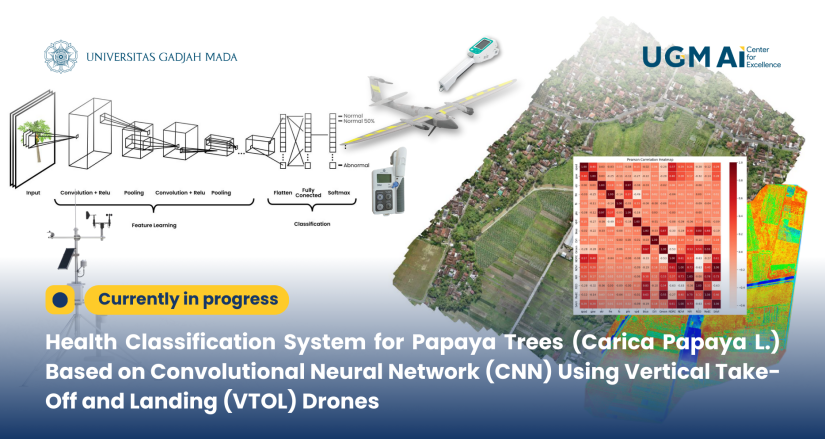
Yogyakarta – Ardan Wiratmoko, S.T.P., M.Sc., a researcher from the Faculty of Agricultural Technology at Universitas Gadjah Mada (UGM), is developing an advanced system to automatically classify the health of papaya trees (Carica papaya L.). This research, conducted in 2025, utilizes aerial imagery from Vertical Take-Off and Landing (VTOL) drones analyzed using Convolutional Neural Networks (CNN), aiming to support more precise plantation management and early detection of plant issues.
This project focuses on integrating drone technology and artificial intelligence to monitor the condition of papaya plants in plantations. VTOL drones, known for their ability to take off and land vertically, are used to collect high-quality aerial images of the plant canopy. These images are then processed using Convolutional Neural Network (CNN) algorithms, a branch of Computer Vision, enabling the system to automatically identify and classify the health status of each tree.
“With this system, we hope to provide an effective tool for farmers to monitor the health of their papaya plants in real time,” said Ardan Wiratmoko. “Early detection of plant diseases or stress is crucial to prevent spread and minimize yield losses, thereby supporting more efficient and sustainable agricultural practices.”
This research, funded by the Faculty’s DIPA, is a collaborative effort with external partners, both national and international, reflecting Universitas Gadjah Mada’s commitment to delivering relevant innovations for the agricultural sector. The expected outputs include classification models/algorithms as well as innovation videos/posters that can serve as implementation guidelines.
The development of this AI- and drone-based papaya tree health classification system is expected to become an important milestone in agricultural modernization. This innovation has strong potential to enhance productivity and sustainability in papaya cultivation, as well as serve as a foundation for future AI-based crop monitoring systems.